
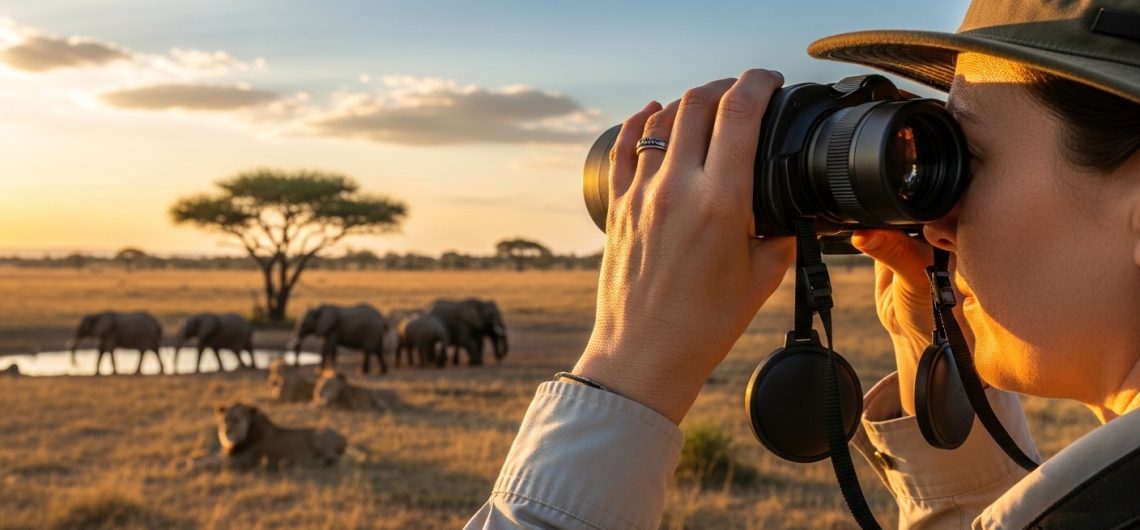
Do you need binoculars for a Kenya-Tanzania safari? Absolutely. While binoculars are not mandatory, they are one of the most useful pieces of safari gear you can pack. They bring distant wildlife, birds, and landscape details into clear view without requiring you to move closer to animals.
For travelers planning Kenya Safaris, Tanzania Safaris, Kenya Wildlife Safaris, Kenya Birding Safaris, Kenya Cultural Safaris, or Tanzania Wildlife Safaris, a good pair of binoculars can make ordinary sightings much more rewarding. They are particularly valuable when watching lions, elephants, giraffes, rhinos, birds, and migratory herds across the expansive landscapes of the Maasai Mara and Serengeti.
Binoculars also support responsible wildlife viewing. Rather than approaching animals for a closer look, you can observe their behavior from a safe and respectful distance. This becomes especially valuable when combining a Kenya or Tanzania safari with Uganda Gorilla Trekking, where wildlife experiences range from open savannahs to dense tropical forests.
At Amakula African Safaris, we recommend considering binoculars an essential safari accessory. They help travelers spot animals that may otherwise be difficult to see, appreciate wildlife behavior in greater detail, and get more from every game drive and birding experience.
Why Are Binoculars Important on a Kenya Safari?
Kenya’s diverse safari destinations offer excellent opportunities for wildlife viewing, but animals are not always close to the vehicle. A pair of binoculars allows you to scan large areas and observe wildlife without disturbing it.
Maasai Mara National Reserve
The Maasai Mara National Reserve is one of Kenya’s most celebrated wildlife destinations and a major setting for the Kenya Great Migration. Its open grasslands make it possible to see large concentrations of wildebeest, zebra, gazelles, lions, cheetahs, and other wildlife.
Binoculars are particularly useful when animals are several hundred meters away. You can watch predator-prey interactions, identify individual animals, and follow distant herds while remaining inside your safari vehicle.
The Mara is also excellent for Kenya Birding Safaris. Birds such as lilac-breasted rollers, African fish eagles, vultures, and various raptors may be perched high in trees or flying overhead. Binoculars make identification easier while allowing you to appreciate plumage and behavior without approaching nesting or feeding areas.
During Kenya Cultural Safaris, binoculars can also encourage respectful observation. When viewing landscapes or community activities from appropriate designated locations, optical equipment allows travelers to appreciate their surroundings without unnecessarily intruding on people’s privacy.
Amboseli National Park
Amboseli National Park is famous for its spectacular views of Mount Kilimanjaro and its large elephant herds. Its relatively open landscapes are ideal for using binoculars to observe elephants, giraffes, lions, cheetahs, and numerous bird species.
Binoculars are especially helpful around Amboseli’s wetlands, where water attracts a wide range of wildlife and birds. Flamingos, pelicans, storks, and other waterbirds can often be easier to identify through binoculars.
For travelers interested in both wildlife and Kenya Cultural Safaris, the destination also provides opportunities to learn about Maasai communities and pastoralist traditions. As with wildlife observation, cultural encounters should always be conducted respectfully and according to local guidance.
Do You Need Binoculars for Tanzania Wildlife Safaris?
Yes. Tanzania’s enormous wilderness areas make binoculars particularly valuable.
Serengeti National Park and the Great Migration
The Serengeti National Park is characterized by vast open plains where wildlife can be spread across considerable distances. During the Tanzania Great Migration, enormous herds of wildebeest and zebra move across the ecosystem, sometimes extending far beyond what the naked eye can comfortably follow.
Binoculars help you:
- Locate distant wildlife.
- Follow migrating herds.
- Identify predators among large groups of animals.
- Observe lions, cheetahs, and other predators from a safe distance.
- Study animal behavior without getting closer.
- Spot birds and smaller wildlife that may be overlooked.
For Tanzania Birding Safaris, binoculars are equally valuable. Birds can be found around rivers, woodland, grassland, kopjes, and other habitats, and many species are much easier to identify with magnification.
Ngorongoro Crater
The Ngorongoro Crater offers another excellent reason to carry binoculars. Its expansive floor supports rhinos, lions, elephants, wildebeest, zebras, gazelles, and many other species.
Because wildlife can be spread across the crater floor, binoculars help you observe animals that are too distant for detailed viewing with the naked eye. They also make birdwatching more rewarding around the crater’s wetlands and other habitats.
For travelers incorporating Tanzania Cultural Safaris, binoculars should be used responsibly and never as a substitute for respectful interaction. Cultural experiences should prioritize consent, privacy, and guidance from local communities and professional guides.
What Binoculars Are Best for an African Safari?
You do not need the most expensive binoculars for a safari. Instead, focus on clarity, magnification, comfort, durability, and low-light performance.
8×42 Binoculars
An 8×42 pair is an excellent all-round choice for most safari travelers.
- 8x magnification provides a wide enough field of view for tracking moving animals.
- 42 mm objective lenses provide good brightness.
- They are generally comfortable to hold for extended periods.
- They work well for both wildlife and birding.
10×42 Binoculars
10×42 binoculars provide greater magnification and can be useful when viewing animals or birds at longer distances.
However, higher magnification can make moving subjects slightly more difficult to track and may produce more noticeable hand movement.
What Should You Look for?
When choosing binoculars for safari, consider:
- Magnification: 8x or 10x is usually sufficient.
- Objective lens: Around 42 mm offers a useful balance of brightness and portability.
- Optical quality: Clear, sharp images are more important than extreme magnification.
- Water resistance: Helpful in unpredictable weather.
- Durability: Choose binoculars that can handle frequent travel.
- Weight: Heavy binoculars can become uncomfortable during long game drives.
- Low-light performance: Useful during early morning and late afternoon drives.
Avoid choosing binoculars solely because they have the highest magnification. Extremely powerful binoculars can be harder to stabilize and may provide a narrower field of view.
Can You Go on Safari Without Binoculars?
Yes, you can. Safari vehicles and professional guides often get you close enough to see many animals clearly with the naked eye.
However, going without binoculars means you may miss details when wildlife is farther away.
For example, you might see a group of lions in the distance but struggle to notice their interactions. With binoculars, you can observe posture, behavior, and social interactions more clearly.
The same applies to birds. A distant raptor or colorful bird may appear as a small silhouette to the naked eye but reveal remarkable detail through good binoculars.
So, while binoculars are not strictly necessary, they are highly recommended.
Binoculars and Responsible Wildlife Viewing
One of the biggest benefits of binoculars is that they encourage non-intrusive wildlife observation.
Responsible safari practices involve maintaining appropriate distances, following park regulations, avoiding unnecessary disturbance, and listening to your guide’s instructions.
Instead of asking a driver to move closer simply because an animal is difficult to see, binoculars allow you to enjoy the encounter from a respectful distance.
This is particularly important during sensitive wildlife moments such as feeding, mating, nesting, or raising young.
Are Binoculars Useful for Uganda Gorilla Trekking?
Travelers combining Kenya Safaris or Tanzania Safaris with Uganda Gorilla Trekking experience very different ecosystems.
Kenya and Tanzania are dominated by open grasslands, woodlands, wetlands, and expansive savannahs, while Uganda’s gorilla trekking takes place in dense forest environments.
Binoculars can still be useful for general forest wildlife and bird observation, although your professional trekking guides will determine how equipment should be used around gorillas and other primates. Travelers should always follow official trekking rules and guide instructions.
This combination of destinations demonstrates why a versatile pair of binoculars can be valuable throughout a multi-country East African adventure.
How to Pack Binoculars for a Kenya-Tanzania Safari
Binoculars are compact enough to fit easily into your safari day bag. Keep them readily accessible rather than buried inside your luggage.
Useful safari accessories include:
- Binoculars
- Protective case
- Neck strap or harness
- Lens-cleaning cloth
- Camera
- Extra batteries or power bank for electronic devices
- Lightweight daypack
- Sun protection
- Reusable water bottle
A protective case helps prevent dust and scratches, while a cleaning cloth is useful after dusty game drives.
How to Reach Kenya and Tanzania Safari Destinations
Many international travelers begin their Kenya Safaris in Nairobi, often connecting through Jomo Kenyatta International Airport, while travelers heading directly into northern Tanzania commonly use Kilimanjaro International Airport.
From these entry points, travelers may continue by domestic flight or guided 4×4 transfer to destinations such as the Maasai Mara, Amboseli, Serengeti, and Ngorongoro Crater.
Keeping binoculars accessible during transfers can be worthwhile because wildlife sightings may occur unexpectedly along the way.
What to Expect During Your Safari
A typical Kenya or Tanzania safari can include early-morning and afternoon game drives, wildlife tracking, birdwatching, scenic viewpoints, and cultural experiences.
Binoculars can enhance all these experiences by allowing you to examine details that are difficult to see from a distance.
You may use them to:
- Scan the horizon for wildlife.
- Watch predators without approaching them.
- Follow herds during migration.
- Identify birds.
- Observe animal behavior.
- Examine distant landscapes.
- Enjoy wildlife from a responsible viewing distance.
For Kenya Best Safaris and Tanzania Best Safaris, having the right equipment can make the difference between simply seeing an animal and truly appreciating what it is doing.
Best Time for Kenya and Tanzania Safaris
Kenya and Tanzania offer wildlife viewing opportunities throughout the year, although seasonal conditions influence animal movements, vegetation, weather, and visibility.
The generally drier periods can provide excellent conditions for game viewing, while migration patterns are particularly important for travelers hoping to witness the Kenya Great Migration or Tanzania Great Migration.
Binoculars remain useful regardless of the season. They can help you locate wildlife through open landscapes, examine birds, and observe animals that remain farther away.
If your itinerary includes Kenya, Tanzania, and Uganda Gorilla Trekking, professional safari planners can help coordinate destinations and seasonal conditions across the different ecosystems.
Why Choose Amakula African Safaris?
Amakula African Safaris provides safari experiences across Kenya, Tanzania, Uganda, and other East African destinations, with a focus on wildlife viewing, birding, cultural experiences, and responsible travel.
Our professional guides can help travelers understand how to use binoculars effectively during game drives and birding activities while maintaining appropriate distances from wildlife and respecting local communities.
Whether you are planning Kenya Safaris, Tanzania Safaris, Kenya Wildlife Safaris, Kenya Birding Safaris, Kenya Cultural Safaris, Tanzania Wildlife Safaris, Tanzania Cultural Safaris, or a multi-country adventure that includes Uganda Gorilla Trekking, the right preparation can significantly enhance your experience.